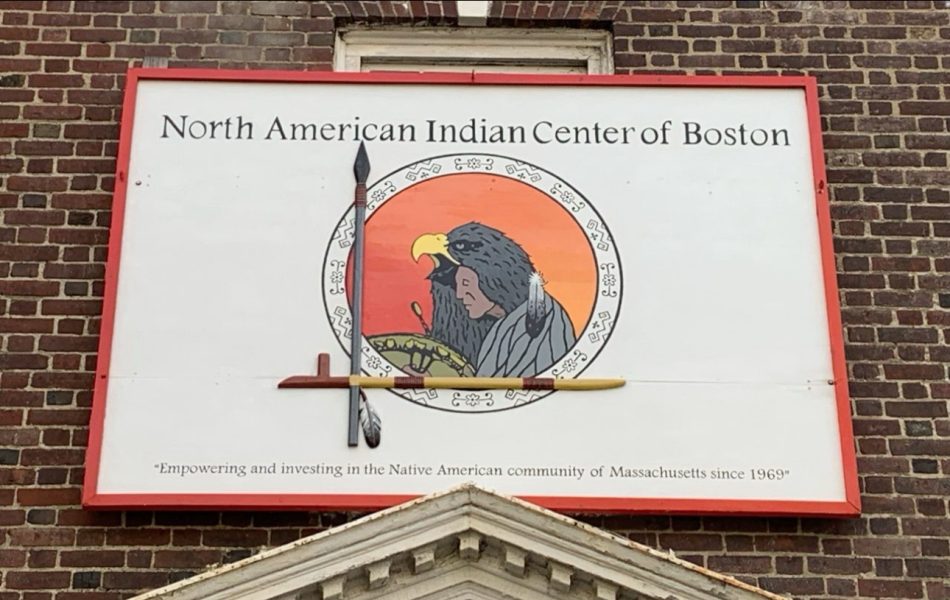
Founded in 1969 North American Indian Center of Boston was founded as Boston Indian Council during the Civil Rights Movement of the mid-twentieth century. It served as a hub for social life and political activism for the urban community of American Indian/Alaska Native and First Nations population in Boston. The group had met in various locations over the years before establishing the Center here in Jamaica Plain in 1974. With services ranging from drop-in recovery programming and Head Start, to artistic and creative expression, the Center has a history of providing innovative programming that reflects both the needs and capacities of the community.
From the founding of Boston Indian Council in 1969 until 1986, eight locations are associated with meetings and cultural and social services of the Boston Indian Council. Lee Braber and Jacquelyn M. Dean place the initial meeting between four Native Americans at the South End Home for Alcoholics. In 1965, Jack Donahue incorporated Hope House on 40-42 Upton Street in Boston’s South End which would make this the most likely location for those meetings. The Arlington Street Church opened up the conversation for a center to the larger community. Boston Indian Council found home spaces at 150 Tremont Street and 405 Washington Street in Dorchester. The latter became a school. Identified within the exterior shots of St. Elsewhere, “Indian Park” (Franklin and Blackstone Squares) was a known point for newcomers and visitors. Boston Indian Council found a more permanent home at the former Boston School for Physical Education at 105 South Huntington Avenue in Jamaica Plain. The Boston Indian Community Development Corporation was at 175 Tremont Street. Finally, Tecumseh House provided recovery services at 107 Fisher Avenue in Roxbury.
The people who served on the first Board of Directors were: Ellsworth Drifting Goose Oakley, Jr., Peter Levi, Jr., Annie Mae Maloney (Pictou Aquash), Frank Basset, Alfred Hallowell, Evelyn Issac, and Patricia Landry. Initial tribal representation in Boston Indian Council included Wampanoag, Mi’kmaq of Nova Scotia and New Brunswick, Penobscot, Passamaquoddy, Lakota, Seneca, Choctaw, Chickasaw, Oneida, Cree, Comanche, Caddo, Mohawk, Ojibwe, and Kiowa. Since the founding of Massachusetts’ oldest urban Indian center, many more American Indian, Alaska Native, and First Nations people contributed to the mission. You’ll find the names of Misqua Wahan Shirley Mills, Annie Mae Pictou Aquash, and Wamsutta Frank James on the Freedom Plaza, which honors 65 civil rights and social justice leaders active in Greater Boston from 1950 –1975. Read more about them here: https://stories.embraceboston.org/heroes
In 1976, Governor Dukakis signed Executive Order No. 126 recognizing the Boston Indian Council as the state’s liaison with resident members of tribes with whom the state holds Treaties and other agreements. Advocates from the Boston Indian Council including former president Will Basque promoted the importance of the Treaty of Watertown in the Commonwealth’s obligation to the membership of Boston Indian Council. The treaty was the first law passed after the signing of the Declaration of Independence.
The BIC reorganized as the North American Indian Center of Boston in 1991. Since then, NAICOB has continued to provide a wide range of cultural, social, educational, and professional services to Native peoples in the Commonwealth as well as public education opportunities. Supported by a 99-year lease, NAICOB calls Jamaica Plain home now and for future generations to come.
Explore Historical Markers
Swipe to see all Everyone250 historical markers. Click or tap any image below to learn more about the marker and the history it commemorates.